

How Brands Stop Counterfeit Packaging: Security Label Technologies Explained
Effective brand protection layers several technologies at different levels: a visible feature consumers can check, a hidden feature investigators can verify, and a unique identity per unit that turns every pack into a data point. Any single measure on its own gets copied.
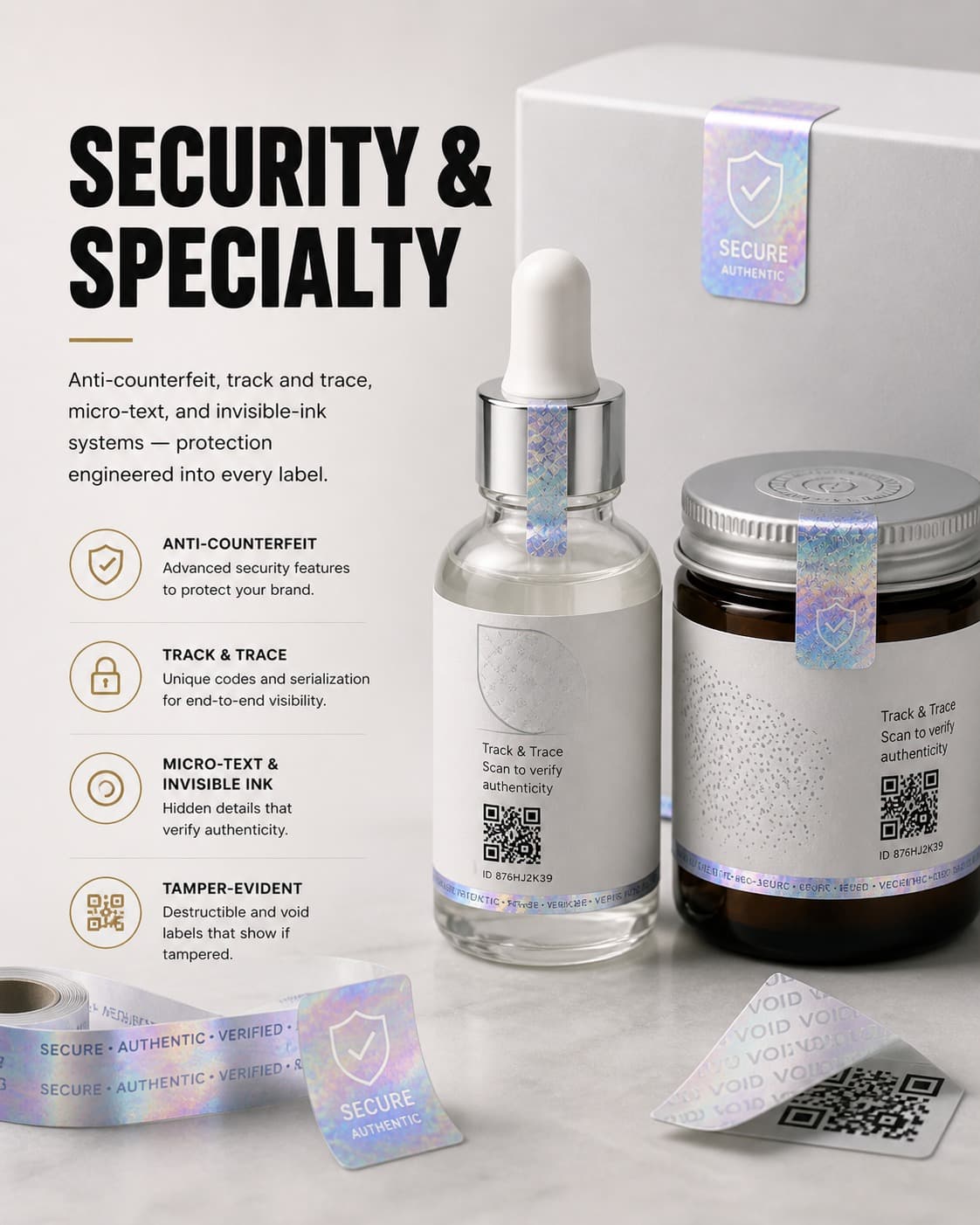
Counterfeiting stops being an abstract risk the moment a customer complains about a product you never made. By then the damage is to your brand, not the counterfeiter's, and the packaging is usually how it happened.
Brand protection works when it is layered. A single clever feature gets studied and reproduced. Several features operating at different levels, some visible to consumers, some verifiable only in a lab, and a unique identity for every unit, raise the cost of a convincing fake past the point where it is worth making.
The three levels of security
Overt features, which anyone can check
Visible to the naked eye and verifiable without equipment. Their job is to let a consumer, a retailer or a distributor confirm authenticity in a second.
- Holograms. The most recognised authentication device. Custom origination is essential, because generic stock holograms are freely available and prove nothing.
- Colour shifting inks. Change hue as the pack is tilted. Difficult to reproduce by scanning and printing, because a photocopy captures one angle only.
- Tamper evident constructions. Labels and seals that destroy themselves on removal, often revealing a void pattern. These protect against refilling as much as against counterfeiting.
- Sequential visible numbering. Simple, cheap, and effective at exposing duplicates when combined with a verification channel.
Covert features, which only you can check
Invisible in normal conditions and revealed with a specific tool. Their value is that a counterfeiter examining a genuine pack does not know they exist.
- UV fluorescent inks. Invisible in daylight, luminous under ultraviolet light.
- Infrared readable inks. Detectable only with an IR reader.
- Microtext. Text printed below the resolution of ordinary scanning and reproduction, which appears as a solid line to the naked eye.
- Guilloche patterns. Fine interwoven line work borrowed from currency printing, which degrades visibly when copied.
- Taggants. Chemical or physical markers embedded in the ink or substrate, verifiable in a laboratory and effectively impossible to reverse engineer.
Forensic and digital, which prove individual identity
The strongest layer, because it gives every single unit a unique identity rather than giving every unit the same clever feature.
- Serialised QR codes. A unique code per unit, linked to a verification service. A consumer scans and learns whether that specific code is genuine and whether it has been scanned before.
- [RFID and NFC tags](/products/acb-rfid-nfc). Read without line of sight, which suits high value goods and warehouse level verification.
- [Track and trace](/verticals/security-labels). Recording each unit as it moves through the supply chain, so diversion and grey market activity become visible.
- Currency grade printing. The techniques used for banknotes and excise stamps, applied to packaging where the value justifies it.
Building a programme that actually works
Technology selection is the easy part. These are the decisions that determine whether a programme succeeds.
Layer across levels, not within one
Three overt features is not a layered programme, it is one layer done three times. One overt feature, one covert feature and a serialised identity is materially stronger and usually cheaper.
Give the overt feature a verification channel
A hologram nobody knows to look for protects nothing. Whoever is meant to check it, consumers, retailers or field inspectors, has to know it exists and what genuine looks like. That means the pack, or a campaign, has to tell them.
Decide who verifies at each stage
Consumers need something instant and free. Distributors can use a handheld reader. Investigators can use a laboratory. Design each layer for its intended audience rather than assuming one feature serves everybody.
Plan to rotate
Any static feature will eventually be copied. Programmes that survive change something on a schedule, a hologram generation, a covert ink, a code format. Build that expectation and its cost into the plan from the start.
Instrument it
Serialisation only pays off if somebody watches the data. Duplicate scans, scans from unexpected geographies and codes activating out of sequence are all early signals. Without monitoring, serialisation is decoration.
Matching investment to risk
| Risk level | Typical categories | Sensible layering |
|---|---|---|
| Low | Commodity FMCG | Tamper evidence plus batch coding |
| Moderate | Personal care, home care | Custom hologram plus UV covert feature |
| High | Pharmaceutical, agrochemical | Tamper evidence, covert ink, serialised QR with verification |
| Severe | Spirits, high value pharma, excise goods | Full layering including currency grade print, RFID and track and trace |
Regulated categories often have this decided for them. Pharmaceutical exports carry serialisation obligations, and wine and spirits packs carry excise requirements that already imply security printing.
Questions to ask a security print supplier
- 01Is the hologram origination custom to us, or from a stock library.
- 02How is security substrate inventory controlled, and what happens to the waste from our runs.
- 03Can you produce covert features in house, or is that subcontracted, and to whom.
- 04How is serialisation data generated, stored and secured.
- 05What does a feature rotation cost and how long does it take.
- 06Can you provide reference examples in a comparably regulated category.
Labelify produces brand protection labels, including custom holograms, covert inks, track and trace and currency grade printing, in house rather than through subcontractors.