

The Complete Guide to Label Printing for Indian Brands
Label printing in India runs on two main technologies, flexographic and digital, and the right choice depends on run length, number of versions and how fast you need stock. This guide covers print methods, face materials, adhesives, finishing, compliance and what actually drives the price of a label.
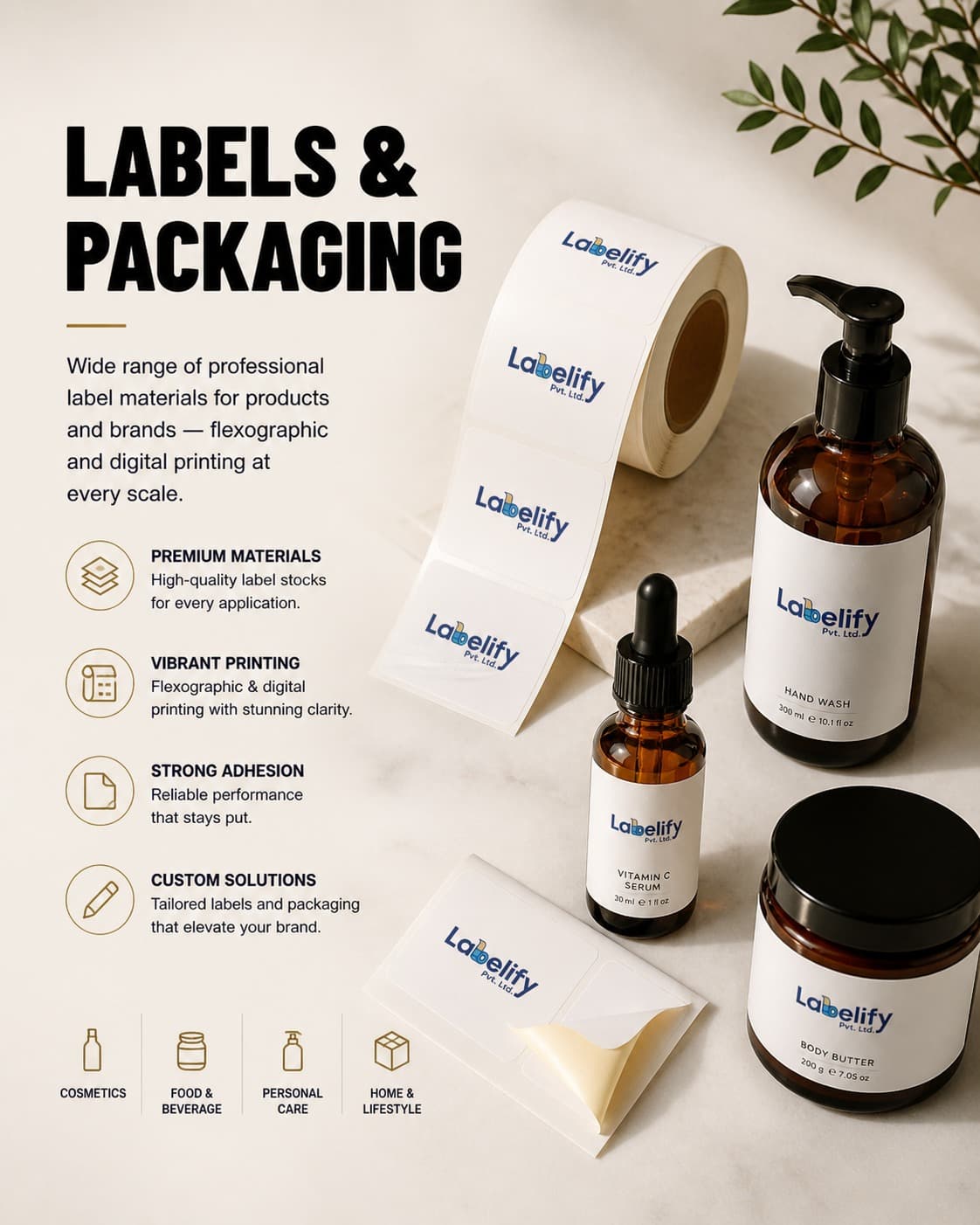
Most packaging teams meet label printing through a quotation, and the quotation hides almost everything that matters. Two suppliers can quote the same label at prices that differ by forty percent because one assumed a paper face with a permanent adhesive and the other assumed a polypropylene face with a wash off adhesive. Neither is wrong. They answered different questions.
This guide walks through the decisions that sit behind a label quotation so you can specify what you actually need. It covers print technology, face materials, adhesives, finishing, regulatory requirements in India and the small number of variables that genuinely move cost.
The two print technologies, and when each wins
Almost every commercial label in India comes off one of two processes. Understanding the economics of each is the single most useful thing a buyer can learn.
Flexographic printing
Flexo uses a flexible printing plate for every colour, wrapped around a cylinder, inking a web of material that runs continuously through the press. Because you make a physical plate per colour, there is a real setup cost before the first good label appears. Once the press is running, the cost per label is very low and it keeps falling as the run gets longer.
Flexo also unlocks decoration that digital struggles to match. Cold foil, hot foil, screen varnish for a raised tactile effect, and heavy opaque whites behind a clear film all behave better on a flexo line. If your label needs to feel expensive, flexo is usually the answer.
Digital printing
Digital printing has no plates. The artwork goes straight from file to press, so setup is close to zero and the first label costs roughly the same as the ten thousandth. The cost per label is higher than flexo, but there is no plate charge to amortise.
That changes what is possible. Twelve flavour variants of a sauce, each needing three thousand labels, is painful and expensive in flexo because you pay plates twelve times. In digital it is one job. The same applies to seasonal artwork, regional language versions, pilot batches for a new SKU, and any label carrying variable data such as batch codes or serialised QR codes.
| Situation | Usually better | Why |
|---|---|---|
| Single artwork, high volume | Flexo | Plate cost spreads across a long run |
| Many versions, low volume each | Digital | No plate cost per version |
| Pilot batch or market test | Digital | Low commitment, fast turnaround |
| Foil, tactile varnish, premium finish | Flexo | Wider decoration toolkit |
| Variable data or serialisation | Digital | Every label can differ |
| Frequent artwork changes | Digital | No obsolete plate inventory |
Face materials, or what the label is made of
The face material carries the print. It decides how the label looks, how it survives, and a meaningful part of the cost.
- Paper. The cheapest option and the most common. Good print quality, wide finish range from matt to high gloss to textured. Paper fails when it gets wet, so it suits dry goods, pharmaceutical cartons, spice packs and anything that never meets condensation.
- Polypropylene, usually written BOPP. A plastic film that shrugs off water, oil and general abuse. This is the default for personal care, home care and most beverage applications. Available as clear, white or metallised.
- Polyethylene. Softer and more flexible than BOPP, so it moves with squeezable bottles instead of wrinkling. The right pick for sauce bottles, lotions and anything a user squeezes.
- Polyester, usually written PET. The toughest common film. Handles heat, solvents and long outdoor exposure. Used where a label has to survive years rather than months, such as durable goods and chemical drums.
- Specialised stocks. Textured papers for wine and spirits, direct thermal for logistics, and security substrates for brand protection.
The practical test is simple. Write down what the labelled product will physically experience between the press and the end of its life. Condensation in a cold chain. A hot fill at eighty degrees. Six months in a warehouse in Rajasthan. A consumer with oily hands. Then pick the cheapest material that survives all of it.
There is a longer treatment of this in our guide on how to choose a label material.
Adhesives are where most label failures start
Buyers specify the face material carefully and then accept whatever adhesive the supplier defaults to. That is backwards. Adhesive choice causes more field failures than any other single decision.
- Permanent. Bonds hard and is not meant to come off cleanly. The default for most consumer goods.
- Removable. Peels away without residue within a reasonable window. Used for promotional overlays and temporary information.
- Wash off. Releases cleanly in a caustic wash so the container can be recycled or refilled. Increasingly required by returnable glass programmes and by brands with recycled content targets. See wash off labels.
- Freezer grade. Stays bonded at temperatures where standard adhesives turn brittle and let go.
- High tack. For rough, textured or low energy surfaces such as recycled board or certain plastics, where a standard adhesive simply will not hold.
Decoration formats beyond the standard label
A pressure sensitive label stuck to a container is the most common format, but it is not the only one, and the alternatives solve real problems.
- [Shrink sleeves](/products/shrink-full-body). A printed film tube that shrinks to the exact contour of the container under heat. Gives 360 degree decoration with no visible seam and works on shapes a flat label cannot follow. Also the standard way to add a tamper evident neck band.
- [In mould labels](/products/iml-bottle-container). The label goes into the mould and the plastic is formed around it, so decoration and container become one piece. Nothing to peel, nothing to lift, and a very clean look. Suits high volume rigid packaging where the tooling investment pays back.
- [Heat transfer labels](/products/heat-transfer-seamless). Decoration is transferred onto the container by heat and pressure and leaves no carrier film. Popular for cosmetics and for complex shapes that resist every other method.
- [No look labels](/products/nolook-transparent). Clear film with clear adhesive, so the graphics appear printed directly onto the container. Heavily used in premium personal care.
- [Pouches](/products/pouch-flexible) and [canisters](/products/canister-rigid). When the packaging itself is the printed surface.
If you are weighing sleeves against conventional labels, we compare them directly in shrink sleeves versus pressure sensitive labels.
What Indian regulation requires on a label
Label compliance in India is governed by more than one authority and the requirements stack. Getting this wrong means a recall, so it belongs in the artwork brief rather than in a final check.
- Legal Metrology Packaged Commodities Rules. Applies to almost every retail pack. Governs the declaration of net quantity, retail sale price inclusive of all taxes, the name and address of the manufacturer or packer, month and year of manufacture, and consumer complaint contact details. It also specifies minimum type heights based on pack size, which is the rule most artwork misses.
- FSSAI regulations. Any packaged food adds the licence number, the vegetarian or non vegetarian mark, an ingredient list in descending order of composition, allergen declarations, nutritional information per hundred grams or millilitres, and date marking.
- Drugs and Cosmetics Rules. Pharmaceutical and cosmetic packs carry their own scheme covering batch number, manufacturing and expiry dates, licence numbers and specific warning statements.
- BIS marking. Required for products under mandatory certification schemes.
Food brands should read our detailed walkthrough of FSSAI labelling requirements before signing off artwork.
What actually drives the price of a label
Buyers often try to reduce cost by negotiating the rate. The larger savings are usually in the specification.
- 01Number of colours. Each additional colour is another plate in flexo and another pass of ink. Going from six colours to four often costs nothing in shelf impact and saves real money.
- 02Run length. The single biggest lever. Setup cost is fixed, so it spreads thinner as the run grows. Consolidating four quarterly orders into one annual order with scheduled releases can cut unit cost sharply.
- 03Face material. Paper to film is a genuine step up in cost. Do not pay for film if the product never gets wet.
- 04Finishing. Foil, embossing, tactile varnish and die cut complexity each add a process. They are worth it on a premium SKU and wasted on a back label.
- 05Label size. Material is bought by area. A label that is ten percent smaller uses ten percent less substrate on every unit you will ever order.
- 06Number of versions. In flexo, every version is a plate set. In digital it is a file. This is the variable that most often makes the difference between the two technologies.
How to brief a label supplier properly
A complete brief gets you an accurate quotation and a label that works. An incomplete brief gets you a cheap quotation and a problem later. Include all of the following.
- 01The container: material, shape, diameter and whether the surface is flat, curved or compound curved.
- 02The application method: hand applied, semi automatic or a specific applicator model and line speed.
- 03The filling conditions: temperature at the moment of application, and whether the surface is wet or dry.
- 04The product itself: is it oily, solvent based, acidic, or does it migrate through films.
- 05The full life of the pack: storage, transport, retail environment and expected shelf life.
- 06Annual volume and how many separate versions make it up.
- 07Every regulatory scheme that applies.
- 08Whether the container has to be recycled or refilled at end of life.
Quality checks that separate suppliers
Print quality is easy to judge on a sample and hard to judge across a run of half a million. These are the controls that keep the last reel identical to the first.
- In line video inspection. Cameras watch the web during the run and flag registration drift, colour deviation and defects while the press is still running, instead of after the job is boxed.
- Spectrophotometer colour control. Colour measured against a numeric target rather than judged by eye under whatever light the shop floor happens to have.
- Barcode verification. Grading every barcode to the ISO scale, not simply scanning one label and assuming the rest are fine.
- Substrate proofing. A proof printed on the exact material of the production run, because the same ink looks different on matt paper and on clear film.
Labelify runs all four as standard, and returns a digital proof on your chosen substrate within one business day.
Where to go next
If you have a live project, the fastest route is to send the brief described above and get a quotation with a substrate proof. If you are still scoping, the cluster guides below go deeper on the individual decisions.