

Shrink Sleeves vs Pressure Sensitive Labels: Which Should You Use
Pressure sensitive labels are cheaper per unit and simpler to apply. Shrink sleeves give 360 degree decoration, follow complex container shapes and provide tamper evidence in the same operation. The right choice depends on container geometry, volume, and whether the pack needs to be recycled.
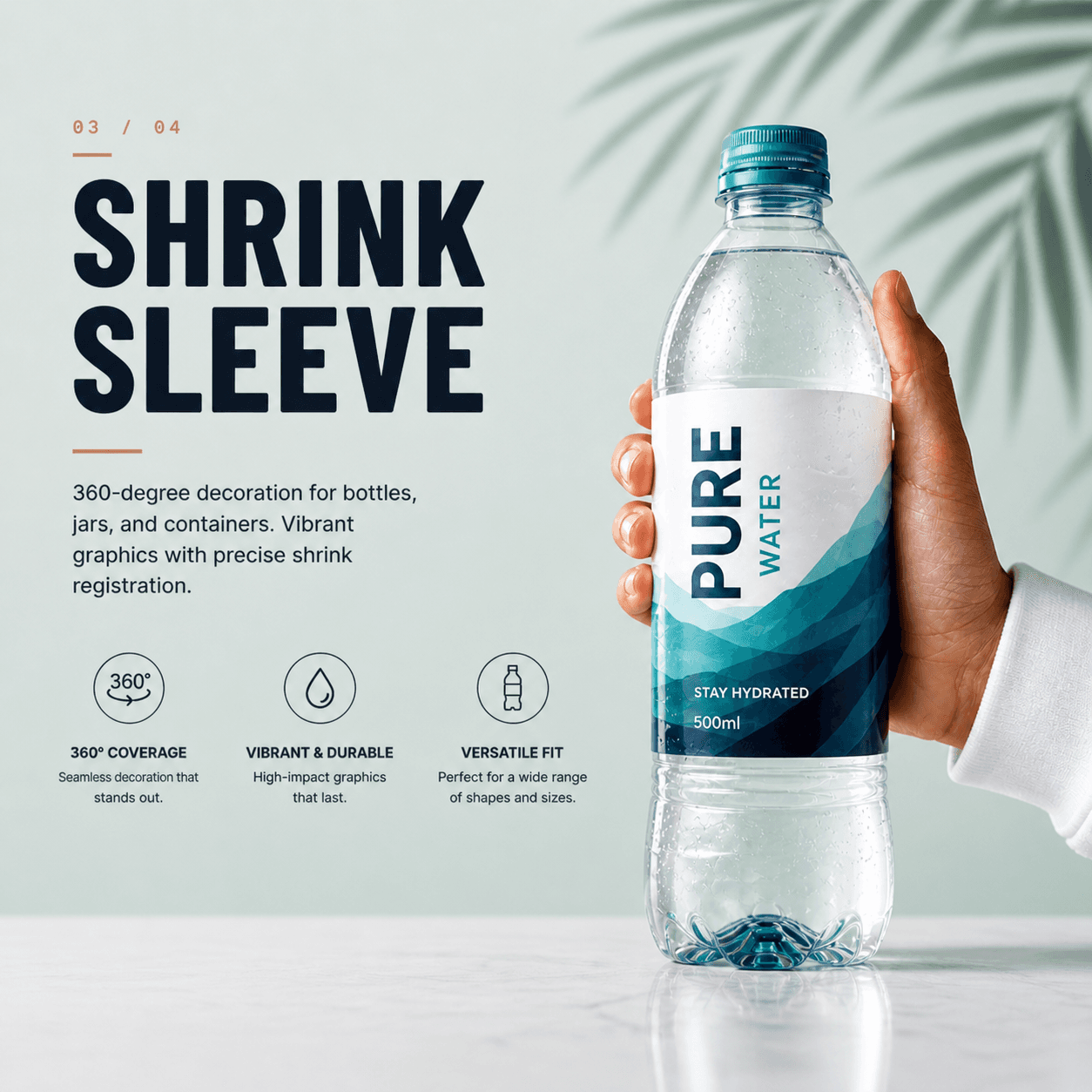
This question usually arrives late, after the container is already tooled and the artwork is nearly signed off. It should arrive first, because the answer changes what the artwork can do and what the filling line has to look like.
Here is the honest comparison, including the cases where sleeves are the wrong answer.
The short version
| Factor | Pressure sensitive label | Shrink sleeve |
|---|---|---|
| Cost per unit | Lower | Higher |
| Decoration area | Flat panel only | Full 360 degrees including neck and base |
| Complex container shapes | Poor, wrinkles and lifts | Excellent, conforms to contours |
| Tamper evidence | Needs a separate component | Built in as a neck band |
| Application equipment | Simple and inexpensive | Applicator plus heat tunnel |
| Line speed | Very high | High but tunnel limited |
| Recyclability | Simple if the label is compatible | Needs a separating sleeve or perforation |
| Small runs | Easy | Viable but less economic |
| Shelf impact | Good | Very high, the pack looks moulded |
When pressure sensitive labels are the right call
For the majority of packs, a conventional label is still correct. Choose it when the container has a usable flat or gently curved panel, when unit cost matters more than maximum shelf impact, and when you want the simplest possible filling line.
- Straight sided bottles, jars and tins where a flat panel exists.
- High volume products where a small unit cost difference multiplies into a large number.
- Products needing frequent artwork changes, since label changeover is faster and cheaper.
- Brands running many low volume variants, which digital printing handles well.
- Any line without space or budget for a heat tunnel.
The range covers everything from food and beverage to chemical resistant applications.
When shrink sleeves earn their extra cost
Sleeves cost more per unit and need more equipment. They win when they do something a flat label physically cannot.
The container is not a cylinder
A waisted bottle, a tapered tub, a bottle with a moulded grip or a compound curve will defeat a flat label. The label either wrinkles at the edges or has to be shrunk so small that it wastes the available decoration area. A sleeve conforms to the whole shape, which is why contoured beverage bottles almost always use one.
You need tamper evidence anyway
If the pack requires a tamper evident seal, compare the true cost. A conventional label plus a separate neck seal means two components, two applications and two suppliers. A tamper evident sleeve delivers decoration and the seal in one operation, and the total cost is often lower than the sum of the parts.
You want the pack to look moulded
A full body sleeve covers the container from base to neck with no visible seam and no substrate edge. On shelf it reads as printed packaging rather than as a bottle with a label on it. For premium positioning this is difficult to match any other way.
You need the whole surface for information
Regulated categories keep adding mandatory text. Nutritional panels, allergen statements, multilingual instructions and warning symbols consume space quickly. A sleeve gives roughly double the printable area of a front and back label on the same container.
The recycling question, answered honestly
This is the strongest argument against sleeves and it deserves a straight answer. A PET bottle wrapped in a PVC sleeve is a genuine problem for recycling streams, because the sleeve material contaminates the PET flake and the full body coverage can defeat the optical sorters that identify bottle material.
There are three workable answers, and any competent supplier should raise them before you ask.
- 01Float separable film. Sleeve materials with a density below one, which float away from PET flake in the wash and separate cleanly.
- 02Perforated tear strip. A vertical perforation so the consumer removes the sleeve in one motion before disposal.
- 03Matched material. A PET sleeve on a PET bottle, so the whole pack goes into one stream.
What sleeves demand from your filling line
Cost the equipment, not just the sleeve. A sleeve needs an applicator to place the tube over the container and a heat tunnel, steam or hot air, to shrink it down.
- Steam tunnels give the most even shrink and handle difficult geometry best, but need a steam supply and add humidity to the line.
- Hot air tunnels are simpler to install and cheaper to run, and are usually adequate for straightforward shapes.
- Either way you need floor space and a validation exercise to tune the shrink profile.
For lower volumes, contract sleeve application is often more sensible than buying equipment. Ask your supplier before assuming you need capital expenditure.
A decision path
- 01Does the container have a usable flat or gently curved panel. If no, use a sleeve.
- 02Does the pack need tamper evidence. If yes, cost a sleeve against a label plus a separate seal.
- 03Is premium shelf presence a primary objective. If yes, a sleeve is hard to beat.
- 04Is your annual volume high and your margin thin. If yes, a pressure sensitive label is usually correct.
- 05Does the pack have a recycling or refill obligation. If yes, specify float separable or matched material sleeves, or use a wash off label.
For the wider context on print methods and materials, see our complete guide to label printing.